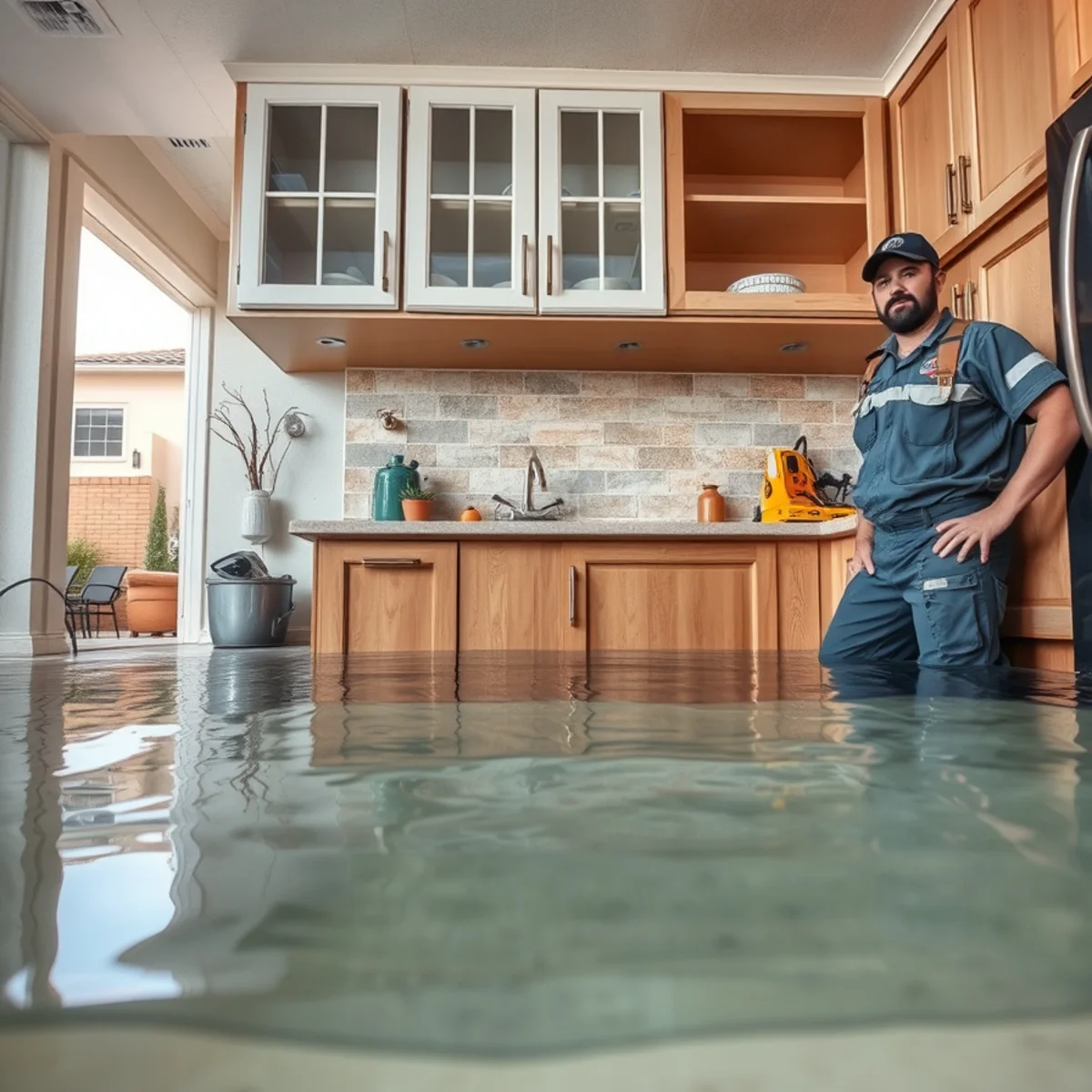
You walk into the kitchen for coffee and step into a cold puddle. The dishwasher ran overnight, something let go, and now there is water across the floor, seeping under the cabinets and toward the pantry.
The puddle you can see is the smaller problem. Because it happened overnight, the water has had hours to travel where you cannot see it — under the toe-kick of your cabinets, into the seams of laminate or hardwood flooring, and down into the subfloor. Cabinet bases are often made of particleboard, which drinks water and swells, and a kitchen is one of the harder rooms to dry because so much of the structure is boxed in and hidden.
Here is how to handle it so an overnight leak does not become a torn-out kitchen.
Turn off the water and the dishwasher
Open the cabinet under the sink and find the small shutoff valve on the dishwasher supply line — often a branch off the hot-water valve — and turn it clockwise. Then switch off the dishwasher's power at the breaker so it does not try to finish its cycle. If you cannot find the valve, shut off the home's main water valve.
Get the standing water up
- Pull towels and a wet/dry vac across the visible water, working toward the leak.
- Open the dishwasher and cabinet doors so trapped water can drain out and air can reach inside.
- Move rugs, small appliances, and anything on the lower shelves out of the wet zone.
- Pull the kick plate off the bottom of the dishwasher and nearby cabinets if you can, so water underneath has a path out.
Work fast, but do not start pulling cabinets apart yourself — you can do more harm than good, and you may need those materials intact for the adjuster. Your job right now is the standing water; the hidden water is ours.
The water you cannot see is the real problem
This is where kitchens fool people. Wipe the floor, and it looks solved. But water has almost certainly gone under the cabinet toe-kicks, along the subfloor, and into the gap beneath your flooring. Under a dishwasher, it often runs backward under the cabinet run where no towel will ever reach.
Laminate is especially unforgiving. Once water gets into the seams, the fibreboard core swells and the planks lift at the edges, and unlike solid hardwood it cannot be sanded and refinished. Catching and drying it fast is sometimes the difference between saving the floor and replacing it.
Cabinet bases and subfloor stay wet long after the floor looks dry
Particleboard cabinet bases and the subfloor under your flooring can hold moisture for weeks while the surface looks perfectly dry. That trapped water is exactly what grows mold in 24 to 48 hours, and it is why a mop is never enough after a real leak.
What we check before we call it dry
- Moisture readings inside the cabinet bases and toe-kick spaces.
- The subfloor and the gap beneath your flooring, where water pools.
- The wall behind and beside the dishwasher.
- The ceiling of any room directly below, if the kitchen is on an upper floor.
We keep drying and monitoring until those readings match the dry parts of your home, then document the numbers for your records and your claim.
Why kitchens are tricky to dry
A bedroom is mostly open floor. A kitchen is a maze of enclosed cavities — under the cabinets, behind the toe-kicks, beneath the dishwasher and the flooring. Drying it properly means getting airflow into those hidden spaces, which sometimes means removing a kick plate or a base panel and placing air movers to push dry air underneath. Our crews use moisture meters to find where the water actually went and water extraction plus targeted structural drying to reach the parts a towel cannot.
Water damage right now? Don't wait.
45-minute average dispatch across Murrieta • available 24/7 • licensed & insured
Should you file a claim?
A sudden dishwasher failure is often covered by homeowners insurance, while a slow leak that dripped for months usually is not. Either way, photograph the dishwasher, the water, and the affected cabinets and flooring before you clean up, and keep any failed part. If cabinets or flooring need to be removed and mold has started, you will be glad you documented it. Our team can also coordinate any mold remediation if the water sat long enough to need it.
If the leak turns out to have been dripping slowly for weeks rather than failing overnight, the claim gets trickier, since insurers treat gradual leaks differently from sudden ones. Either way, the photos you take before cleanup are what protect you.
We handle overnight kitchen floods across Murrieta, including Bear Creek and Murrieta Oaks, 24/7. Catch the standing water yourself, then let us dry the parts you cannot reach. Call our team and we will make sure your cabinets and subfloor are genuinely dry — not just dry on top.
Frequently Asked Questions
Very likely, yes. Water from a dishwasher runs under the cabinets, toe-kicks, and flooring, and those enclosed spaces stay wet for weeks while the surface looks dry. That hidden moisture is what causes swelling, odor, and mold.
It depends on how long the water sat and what they are made of. Particleboard bases swell and may need replacement, while solid wood often survives if dried quickly. Fast, thorough drying is what gives your cabinets the best chance.
Mold can begin within 24 to 48 hours in the damp, enclosed spaces under a kitchen. Because a dishwasher leak feeds exactly those hidden cavities, drying them out quickly is the key to avoiding a mold problem.
A sudden, accidental failure is often covered, while a slow long-term leak usually is not. Photograph everything, keep the failed part, and review our guide on California water damage coverage.
Written & reviewed by the Water Damage Restoration Murrieta team
IICRC-certified, licensed & insured water damage restoration professionals serving Murrieta and southwest Riverside County. Questions about your situation? Call (201) 277-9344 — we answer 24/7.
Serving these areas: