
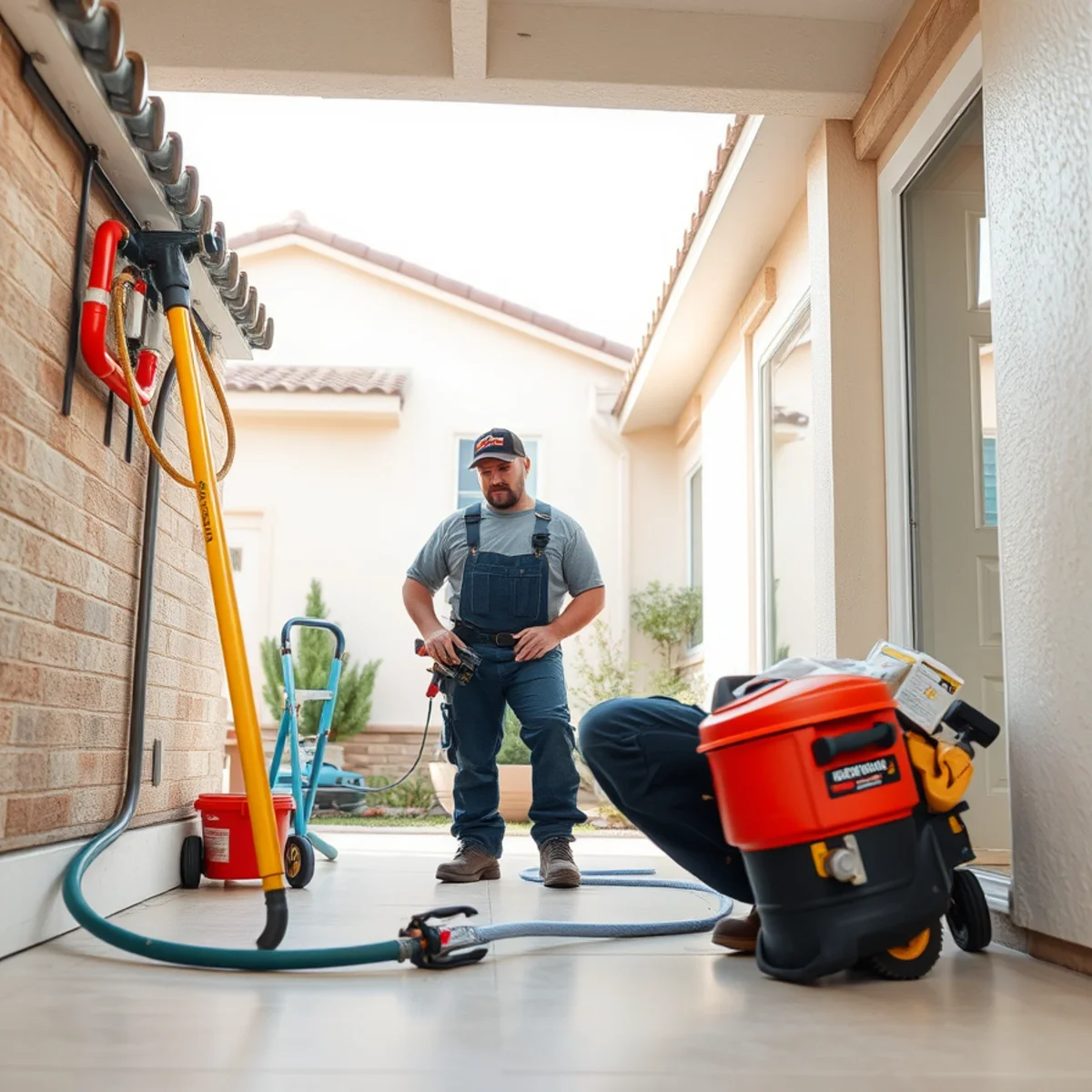
A leak detection specialist just confirmed you have a slab leak, and now you are facing a choice: fix the one spot that failed, or repipe the whole house and be done with it. It is a big decision, and the right answer depends on your plumbing, your home, and how much risk you want to carry going forward.
Here is a plain look at the options, how to decide between them, and what California homeowners insurance typically will and will not pay for. We will keep the plumbing repair pricing general — a licensed plumber quotes the pipe work itself — and focus on the tradeoffs and the water-damage side we handle directly. This is general information, not insurance advice; check your own policy.
First, what a slab leak actually is
A slab leak is a leak in one of the water lines running through or beneath the concrete foundation your home sits on. Many Murrieta homes built from the 1990s through the 2010s are slab-on-grade, with copper supply lines cast into or under the slab. Those lines are now reaching the age when the original plumbing starts to fail — and our first repair cycle for local slab homes explains why the timing is landing now.
Option 1: Spot repair
A spot repair opens the slab at the single point of failure and fixes or replaces that section of pipe. It is the least invasive and least expensive option up front, and it makes sense when the leak is isolated, the rest of the plumbing is in good shape, and the home is relatively young. The downside: if the pipe is failing because of age or water chemistry, fixing one pinhole does not stop the next one from forming somewhere else.
Spot repairs also mean betting on the rest of the plumbing. If a scan shows the failure is a one-off — a spot where the pipe rubbed against rebar or a fitting gave out — a spot repair is reasonable. If the pipe walls are thinning throughout from years of hard water, you may be back under the slab within a year or two.
Option 2: Reroute a single line
Instead of breaking the slab, a plumber can abandon the leaking line in the concrete and run a new line for that fixture through the walls or ceiling. It avoids jackhammering the floor and is a solid middle path when only one line is the problem. It does not address the rest of the in-slab plumbing, though.
Option 3: Whole-house repipe
A repipe replaces the home's supply plumbing entirely, typically routing new lines through the walls and attic and away from the slab. It is the largest single expense and the most disruptive, but it resets the clock: no more slab leaks in those lines, and modern materials that stand up better to local water. For an older home that has already had more than one leak, it is often the more economical choice over a five- or ten-year horizon.
A repipe is disruptive for a few days — walls are opened at intervals and patched afterward — but it is a one-time event. Many homeowners pair it with the drywall repair the water damage already required, so the walls are open anyway. Over a long stay in the home, replacing the plumbing once often beats paying for repeated spot repairs and the water damage each new leak causes.
How to decide
- Age of the plumbing: a one-off leak in a newer home leans toward spot repair; original pipe in a 25-plus-year-old home leans toward repipe.
- Number of leaks: your first slab leak is one data point, but a second or third is a pattern that points to a repipe.
- Water chemistry: Murrieta's hard water accelerates pinhole leaks in copper, which shortens how long a spot repair buys you.
- Your plans: staying long term makes a repipe's peace of mind worth more; selling soon changes the math.
There is no universal right answer, only the one that fits your situation. A five-year-old home with a single fluke leak and a thirty-year-old home on its third pinhole are genuinely different decisions, even though both are called a slab leak.
Why local water matters here
Inland Empire groundwater is hard, with a high mineral content that eats away at copper from the inside and causes pinhole leaks. If your first slab leak is copper and your home is on original plumbing, ask your plumber whether the pipe itself is near end of life — our look at hard water and copper pipes covers the why.
What insurance covers, and what it does not
This is where expectations and reality often part ways. In California, a standard homeowners policy generally covers the water damage a sudden slab leak causes — the wet flooring, baseboards, and drywall — and frequently covers access, meaning the cost to break and later patch the slab to reach the pipe. What it usually does not cover is the plumbing repair itself: fixing or replacing the failed pipe, and certainly not a full repipe, which is treated as an upgrade or maintenance. So the cleanup and drying may be a claim, while the pipe work comes out of pocket.
Because the split between covered and not-covered is so specific here, this is a claim where documentation and order of operations really matter. Get the leak located and photographed, confirm with your insurer what access and mitigation they will pay for, and keep the plumbing invoice separate from the restoration invoice so each is easy to submit against the right part of your policy.
Confirm coverage before demolition
Access and mitigation coverage varies by policy, and some policies exclude slab leaks entirely. Call your insurer and confirm what is covered before anyone breaks concrete, and document the leak and damage first so the claim is clean.
Water damage right now? Don't wait.
45-minute average dispatch across Murrieta • available 24/7 • licensed & insured
Where we fit in
We are the restoration side of this equation. Once the leak is located and the plumber does the repair, our crews handle the slab leak restoration — extracting the water, drying the slab and affected materials, and putting the space back together. We also offer leak detection to pinpoint the leak without tearing up the whole floor, and we work alongside your plumber so the job flows in the right order. We serve Murrieta neighborhoods including The Colony and Alta Murrieta.
Spot repair, reroute, or full repipe — there is no single right answer, only the one that fits your home's age, your water, and your plans. Get a licensed plumber's assessment of the pipe, confirm your coverage before demolition, and lean on us for the water damage and drying. Again, this is general guidance, not insurance advice; your policy is the final word. Questions about the restoration side? Call our team.
Frequently Asked Questions
Standard policies often cover the resulting water damage and the access to reach the pipe, but usually not the pipe repair itself, and never a full repipe, which is considered an upgrade. Some policies exclude slab leaks entirely, so confirm your coverage before any demolition.
A single leak in a newer home usually justifies a spot repair. Repeated leaks, original plumbing in an older home, or copper pipe being eaten by hard water point toward a whole-house repipe, which costs more up front but stops future slab leaks in those lines.
Many local homes are 1990s-to-2010s slab-on-grade builds on original copper, now reaching first-repair age, and the Inland Empire's hard water accelerates pinhole corrosion from the inside. That combination is why one leak is often followed by another.
A licensed plumber repairs or reroutes the pipe, and a restoration crew like ours dries the slab and repairs the water damage. We also offer leak detection to find the leak with minimal demolition and coordinate the work in the right order.
Written & reviewed by the Water Damage Restoration Murrieta team
IICRC-certified, licensed & insured water damage restoration professionals serving Murrieta and southwest Riverside County. Questions about your situation? Call (201) 277-9344 — we answer 24/7.
Serving these areas: