
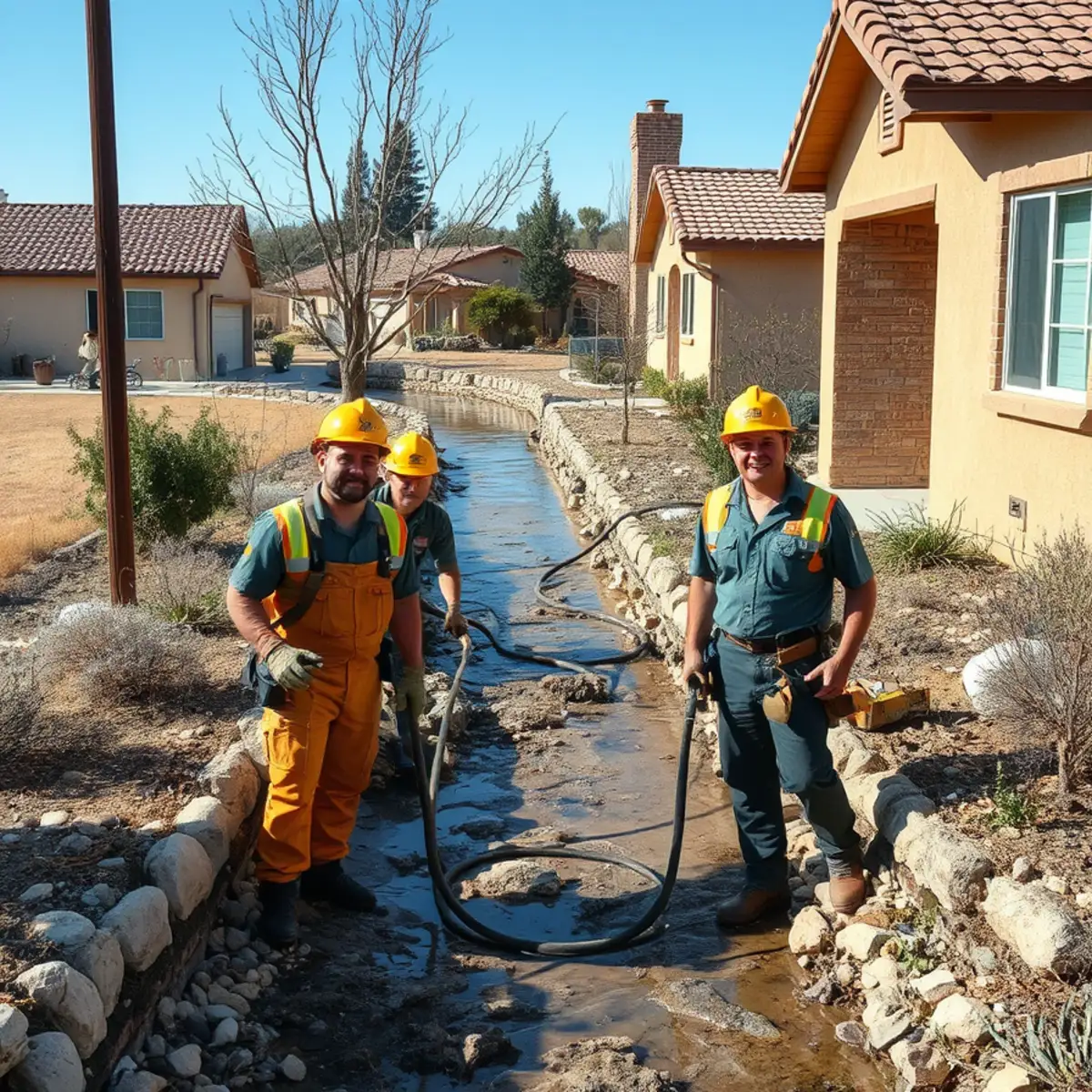
Long-time residents of Temecula and Old Town Murrieta still talk about the winter of 1993. That January, a series of storms pushed Murrieta Creek far past its banks, and the flooding that followed remains the worst on record for the entire watershed. More than three decades later, the event is worth remembering — not to alarm anyone, but because the conditions that caused it have not gone away. The creek is quieter and better managed now, but the physics behind that winter have not changed one bit.
What happened in January 1993
A run of powerful winter storms hit Southern California in January 1993, dropping heavy rain across the region over a short stretch. In the Murrieta Creek watershed, the ground could not absorb it fast enough. Water sheeted off the hills, filled the creek, and spread across low-lying areas along the channel. Old Town and the nearby stretches of Temecula took the brunt of it, with flooded streets, damaged buildings, and businesses under water. The damage in the Temecula area came to roughly 12 million dollars. Just down the watershed, nearby Camp Pendleton saw an estimated 88 million dollars in flood damage. Beyond the dollar figures, the real toll was disruption — families displaced, roads and bridges closed, and a cleanup that stretched on for weeks after the water receded. Those weeks of drying out and rebuilding are the part that rarely makes the history books, but they are exactly what shapes how a community prepares for the next storm.
By the numbers
The January 1993 storms caused roughly $12 million in flood damage in the Temecula area and about $88 million at nearby Camp Pendleton. It remains the Murrieta Creek watershed's worst flood on record.
Why the watershed floods the way it does
Murrieta Creek collects runoff from a wide area of hills and valleys before flowing south toward its confluence with Temecula Creek and, eventually, the Santa Margarita River. When a strong, wet storm system stalls over the region, all of that water converges on the channel at once. Our dry summers make it worse: hard, sun-baked soil sheds water rather than soaking it up, so a higher share of every inch of rain ends up in the creek. Add debris and sediment in the channel, and the water level can rise faster than people expect.
What has changed since 1993
The flood pushed local and federal agencies to take the creek seriously. Over the years, work on the Murrieta Creek flood control project — managed in part by the Riverside County Flood Control and Water Conservation District along with the Army Corps of Engineers — has aimed to widen and improve the channel, add detention basins, and reduce the risk to Old Town. Those improvements have helped. But flood control reduces risk; it does not erase it. Large parts of the corridor remain inside the mapped 100-year flood zone, and a storm on the scale of 1993 would still be a serious event.
The lessons that still apply
You cannot control the weather or the creek, but the 1993 flood points to a few things every homeowner near the channel can do:
- Respect the flood zone. If your property sits in or near the mapped area, treat flooding as a real possibility, not a historical footnote.
- Carry flood insurance. Standard homeowners policies do not cover creek and surface flooding, and flood policies have a 30-day waiting period.
- Move what matters up high. Documents, keepsakes, and mechanical equipment survive better when they are not at floor level.
- Watch the forecast in a wet winter. Back-to-back storms, like the ones in 1993, are the dangerous pattern — the ground is already saturated when the next system arrives.
- Have an exit plan. Roads near the creek can close quickly; know an alternate route out.
Saturated ground is the warning sign
The 1993 disaster was not one storm — it was several in a row. When storms stack up in a wet winter and the soil is already soaked, even a moderate system can flood. That is the pattern to watch.
Water damage right now? Don't wait.
45-minute average dispatch across Murrieta • available 24/7 • licensed & insured
Why an old flood still matters to a new homeowner
It is easy to file a 1993 event under history, especially if your home was built after it. But two things carry forward. First, the watershed and the weather have not changed — the same hills shed water into the same channel when the same kind of storm arrives. Second, much of the housing near the creek predates or barely postdates the flood-control work, and drainage that is adequate for a normal winter can be overwhelmed by an exceptional one. If you own a home in or near the corridor, the practical takeaway is not fear but paperwork: pull your flood-zone status, price a flood policy, and know your evacuation routes before you need them. The people hit hardest in 1993 were not careless — most had simply never seen the creek do that. You have the advantage of knowing it can, and that knowledge is worth acting on while the weather is calm.
If a storm overwhelms your home today
Flood water moves fast and it does not wait for business hours. If a storm pushes water into your home, the priority is getting people to safety and then getting the water out before it soaks deep into floors, walls, and framing. Creek and storm water is usually contaminated, so it needs proper handling. Our Murrieta team provides flood cleanup, storm damage cleanup, and 24/7 emergency water removal, and we follow IICRC S500 standards for extraction and drying. We are local to Murrieta and Temecula, we are licensed and insured, and we answer the phone around the clock. If the water is rising, call our 24/7 team for water damage restoration in Murrieta.
Frequently Asked Questions
It remains the worst flood on record for the Murrieta Creek watershed. The January 1993 storms caused roughly $12 million in damage in the Temecula area and about $88 million at nearby Camp Pendleton.
It could. Flood control improvements along Murrieta Creek have reduced the risk, but they do not eliminate it. Much of the corridor is still in the mapped 100-year flood zone, and a storm sequence on the scale of 1993 would still cause serious flooding.
A series of strong storms hit in a short window, saturating the ground so it could not absorb more water. The runoff converged on Murrieta Creek faster than the channel could carry it, spreading into Old Town and low-lying parts of Temecula.
No. Damage from an overflowing creek or surface runoff is excluded from standard homeowners policies. You need separate flood insurance, and because it typically has a 30-day waiting period, it should be arranged before the rainy season.
Written & reviewed by the Water Damage Restoration Murrieta team
IICRC-certified, licensed & insured water damage restoration professionals serving Murrieta and southwest Riverside County. Questions about your situation? Call (201) 277-9344 — we answer 24/7.
Serving these areas: